
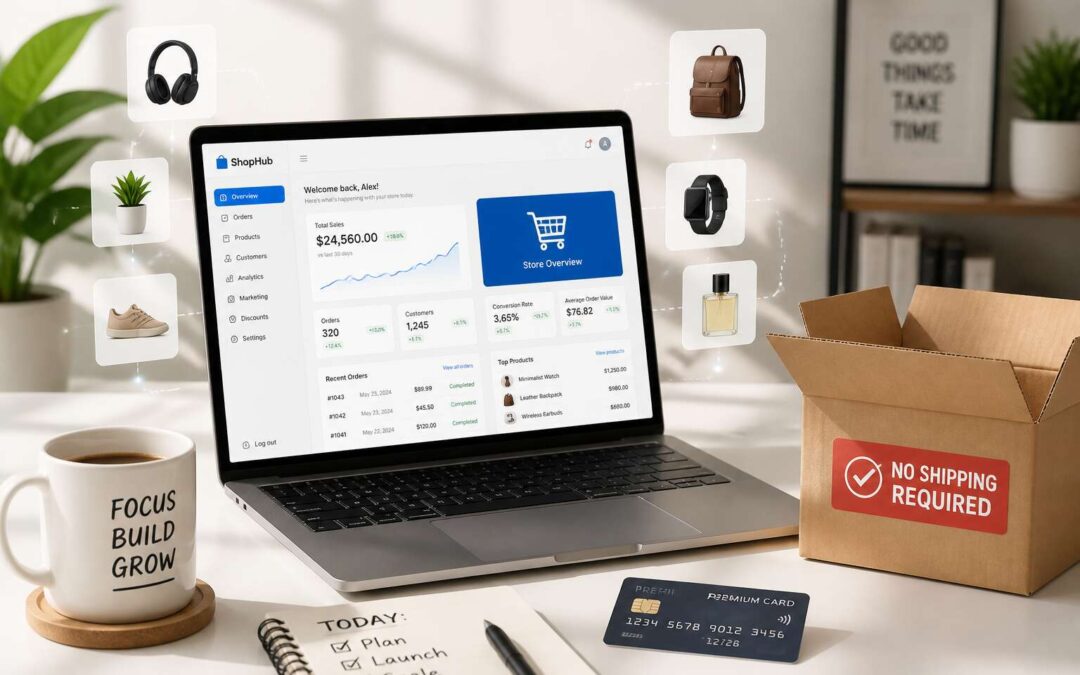
Understanding the Fulfillment-Free Model
Most people hear “dropshipping without shipping” and assume it’s a contradiction. It isn’t. The fulfillment-free model simply removes the supplier from your daily workflow entirely. You still sell physical products, but you never touch inventory, never process returns, and never coordinate couriers.
What does that actually look like in South Africa? You list products, you take payment, and a third party handles everything after the checkout button. I’ve watched sellers assume this removes all responsibility. That assumption costs them customers.
This approach offers a few advantages:
- Zero warehousing costs
- No shipping delays that you must explain
- Full focus on marketing and conversion
But it comes with its own constraints. You have less control over delivery timelines, so customer expectations must be managed early.
Building Your Online Store Without Warehousing
Every South African entrepreneur dreams of a store that exists without the burden of stockrooms and pallets. Yet the path to that reality is obscured by the myth of physical fulfilment. Dropshipping without shipping is a deliberate architecture of digital supply chains.
Consider the mechanics. You connect your customers to a supplier who holds inventory, but you never touch a single box. Your storefront becomes a simple catalogue of customer choices, and your role is to select, not to store. For Capetonians and Joburgers alike, the model sidesteps the snarled traffic and unpredictable courier fees that consume traditional retail margins.
- Supplier holds products in bulk
- You list items at a premium
- Customer buys, supplier dispatches
This system grants you the liberty to scale without leasing a single square metre. Dropshipping without shipping lets you move at the pace of your own decision-making, unburdened by the delays of inventory turnover.
Finding and Vetting Reliable Partners
In South Africa, the ecommerce sector grows by 25% each year. Yet many stores fail within their first two seasons. The culprit is often a broken supply chain. Dropshipping without shipping means your brand depends on a partner you cannot control directly.
Vetting is practical, not theoretical. I order samples. I test communication at odd hours. I verify registration and ask for trade references. Each step reveals more. Here is what I prioritize:
- Delivery speed to different provinces
- Responsiveness during peak times
- Willingness to share failure data
A supplier who hides mistakes will cost you customers. South African logistics demand a partner who knows local routes.
Marketing Strategies for Virtual-Only Operations
The average South African online shopper spends under a minute on a product page before deciding to stay or leave. Virtual-only operations give you no second chance. There is no counter to lean over, no product to touch, no salesperson to read. Your marketing must do all the work before a single click happens.
This is the reality of dropshipping without shipping. In this model, you are not moving boxes. You are moving perception. Every email, every social post, every page load carries the weight of a physical handshake.
Here are strategies that work for virtual-only reach:
- Show real delivery timelines in plain language, not vague estimates.
- Build a photo library of customers using your products in local settings.
- Respond to every comment and message within a few hours.
These actions replace the missing physical touchpoint. When done consistently, they transform a faceless transaction into a familiar relationship. In a market as connected as South Africa, that familiarity travels fast.
Scaling and Optimizing the No-Inventory Workflow
Scaling a business built on dropshipping without shipping sounds like a logistical paradox, yet it is the everyday reality of many South African ecommerce stores. The supplier carries the stock, the courier does the heavy lifting, and your only real job is keeping the order flow clean. That is where the workflow either thrives or collapses.
Automation helps, but only if your supplier syncs properly with your platform. I have seen store owners lose hours reconciling manual spreadsheets when a simple API connection would do. Speed matters, but accuracy matters more. A misrouted order erodes trust faster than a slow delivery.
Some workflows need a human check at specific points:
- order confirmation
- supplier dispatch
- customer follow up
Others run fully unattended. Know which is which!
Legal and Financial Considerations
Nearly 68% of South African shoppers expect delivery within three days. That expectation collides with the reality of dropshipping without shipping, where you never hold stock. I’ve seen business owners treat legal compliance as an afterthought. That is a costly error!
The Consumer Protection Act does not exempt you because a third party fulfills orders. Your contract with the supplier must specify fault, returns, and data handling. Many suppliers include arbitration clauses that force you to litigate abroad. That adds hidden costs to every dispute.
Financial considerations demand equal attention. Your margin shrinks with every failed delivery, refund, or chargeback. Consider these recurring costs:
- Payment gateway fees
- International transfer charges
- Currency fluctuation buffers
- Return postage for defective items
Cash flow becomes a guessing game. You pay the supplier when the order is placed, but the customer might reverse the payment weeks later. Without physical inventory, you lose the ability to absorb delays. Dropshipping without shipping may seem simple, but the legal and financial weight sits squarely on your shoulders.