
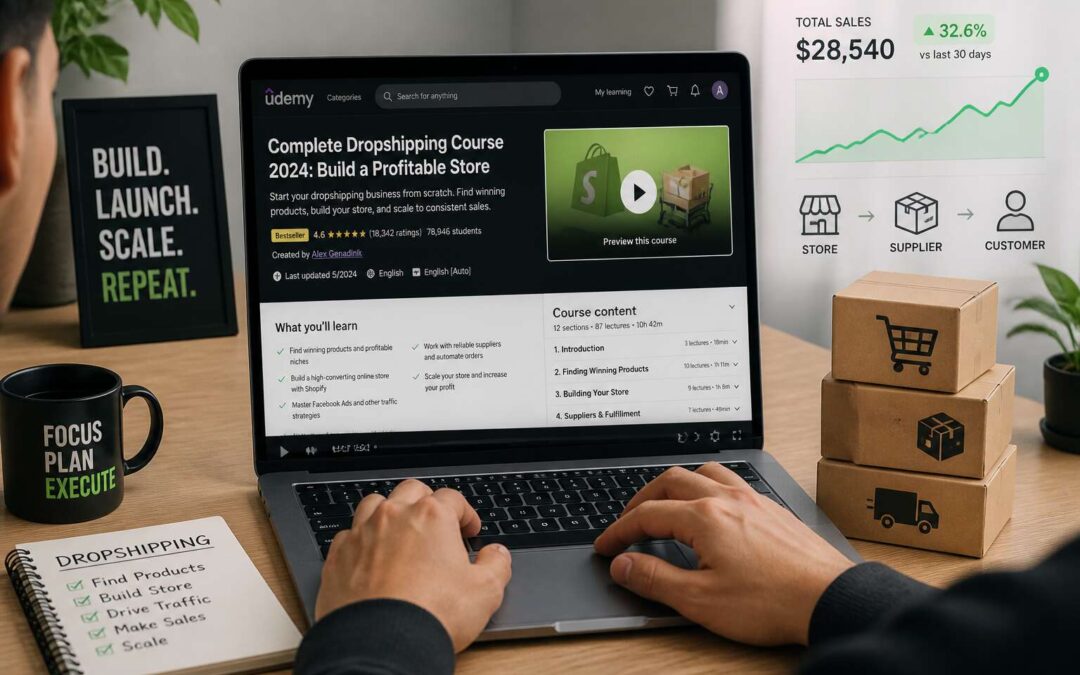
Selecting the Ideal Online Training for Your Ecommerce Venture
Evaluating Instructor Credibility and Experience
According to a 2024 industry survey, nearly three quarters of dropshipping udemy courses are taught by instructors whose only real experience is selling the course itself. That statistic should worry any South African entrepreneur reviewing online training options.
Evaluating instructor credibility requires more than reading star ratings. Look for proof of operational stores, verifiable revenue figures, and student outcomes with actual screenshots. Ask whether the instructor has dealt with supply chain failures or payment gateway disputes. Those practical setbacks reveal more than polished marketing copy ever will.
- Check for dated store dashboards and supplier invoices.
- Verify the instructor’s activity on business forums outside the platform.
- Search for independent reviews from students who completed the training.
Selecting the ideal dropshipping udemy course for your ecommerce venture means treating instructor credentials like a due diligence exercise, not a popularity contest.
Reading Between the Lines of Course Reviews
A five star rating on a dropshipping udemy course rarely survives close inspection. Reviews often reflect enthusiasm from the first module, not the reality of running a store through seasonal demand. South African entrepreneurs should look for patterns across the review history, especially comments that mention challenges like currency fluctuations or supplier delays.
The ideal online training for your ecommerce venture reveals itself through the syllabus, not the sales page. Critical feedback buried in three star reviews frequently contains more practical detail than glowing testimonials. I always check whether students ask pointed questions and receive substantive answers. If every review reads like a template, the entire course warrants suspicion.
Comparing Curriculum Depth Against Your Skill Level
The syllabus of a dropshipping udemy course is the first honest artifact you will encounter. Sales pages promise revenue, but the curriculum shows the real work. Your skill level determines which depth is useful.
A beginner should seek modules on product research and supplier negotiation. An established operator needs advanced topics like scaling paid traffic or managing cash flow across currencies. Look for these markers of curriculum depth:
- Case studies with real numbers
- Module on returns and refunds
- Handling seasonal demand spikes
For South African entrepreneurs, the currency challenge is real. A course that addresses ZAR exchange rate fluctuations in its curriculum shows awareness of local conditions. Comparing that depth against your own experience prevents boredom or bewilderment.
Spotting Outdated Strategies and Red Flags
Payment processors rewrite their terms every few months. Ad platforms alter their algorithms without warning. A dropshipping udemy course that fails to mention these realities is not a course, it is a historical document. The red flags appear when you look closely at what the training still recommends.
Signs of outdated strategy include:
- Facebook Groups as a primary traffic source
- Payment gateways that South African shoppers cannot access
- Product research methods tied to a single, now defunct tool
- No mention of mobile-first shopping behaviour
These symptoms reveal a syllabus untouched since launch. The strongest dropshipping udemy programs revise material annually, reflecting platform changes and local constraints. When the content reads like it was written for a different country and a different year, you have identified the problem.
Essential Knowledge Blocks Covered in Modern Dropshipping Programs
Product Research and Niche Selection Techniques
Three months into their journey, many South African entrepreneurs discover that the real skill in dropshipping is not knowing where to click, but knowing what to sell. Modern dropshipping udemy programs dedicate entire modules to product research and niche selection.
Customer psychology sits at the core. You learn to identify problems, evaluate market saturation, and calculate profit margins using live data tools. A good course separates trends from durable demand.
For niche selection, the curriculum covers:
– Overlap between personal interest and market size
– Validation through search volumes and social media buzz
– Shipping times in supplier selection across regions
What sets contemporary training apart is ethical research. You practice reverse engineering successful stores without copying them. This turns a store into a serious venture. Additionally, dropshipping udemy courses teach you to build a private supplier network to protect margins.
Supplier Sourcing and Negotiation Tactics
Supplier sourcing in modern dropshipping udemy programs has shifted from simple browsing to rigorous vendor vetting. You learn to assess certifications, request samples, and negotiate shipping terms that suit the South African market. The relationship you build with suppliers determines your margins more than any other variable.
A competent course walks you through communication protocols, payment terms, and the balance of securing lower prices without alienating your vendor. There is a psychological component to negotiation that newcomers overlook, and experienced instructors highlight patterns that lead to successful outcomes.
- Understanding freight forwarding options for local delivery
- Setting up backup suppliers to prevent stock disruptions
- Evaluating ePacket and other shipping alternatives
Dropshipping udemy training also covers contracts, return policies, and handling defective products. These knowledge blocks transform a fragile operation into one that absorbs shocks. Whether you are building a side income or a full venture, dropshipping udemy courses provide the sourcing backbone that keeps your store alive.
Building a High-Converting Store with Platforms
Building a high-converting store requires more than picking a theme. Modern dropshipping udemy programs teach you how to structure product pages, streamline checkout, and use platform analytics to identify friction points. South African store owners often underestimate the impact of local payment gateways and page speed on conversion rates.
You also learn to work with page builders, email capture tools, and abandoned cart sequences without needing a developer. The best courses show you how to test layouts and adjust messaging based on real customer behaviour. This practical focus separates useful training from generic theory.
- Configuring shipping zones and tax rules for South African provinces
- Integrating payment methods like PayFast and Ozow
- Using apps to automate order tracking and customer notifications
These blocks give you the technical foundation to launch quickly and refine as you grow. A solid dropshipping udemy course turns platform confusion into a clear workflow.
Paid Advertising Fundamentals for Beginners
The average South African store owner spends R2,000 on paid ads before the first order lands. A dropshipping udemy course that teaches advertising fundamentals shifts that expense into a learning curve instead of a gamble. You learn to track pixels, test creatives, and segment audiences by province rather than shooting into the void. Meta remains the default, but I have seen beginners win with TikTok and Google Shopping when they understand bid caps and daily budgets.
– Reading CTR and ROAS as performance signals, not vanity numbers
– Scheduling campaigns around peak activity in Johannesburg and Durban
– Building retargeting sequences that respect a customer’s hesitation
These building blocks turn ad platforms into controlled experiments. The right dropshipping udemy program shows you how to spend small, interpret the dashboard, and scale only when the data supports it. That is the difference between burning cash and growing a store.
Organic Traffic Generation and Content Marketing
Organic traffic generation is where patience becomes a competitive advantage. A quality dropshipping udemy course teaches you to build content that pulls customers in without draining your budget. I have seen store owners in Cape Town double their monthly orders just by answering questions their competitors ignore. South African shoppers search differently. They look for specific solutions, often in local Facebook groups or on Google with location-based queries.
A solid dropshipping udemy program walks you through content marketing basics: creating product demos, comparison posts, and answers to common objections in plain language. You learn to repurpose one video into blog posts, carousels, and short clips for TikTok.
– Using Google Search Console to find what local customers type before buying
– Writing product descriptions that answer hesitation directly
– Building a simple email sequence that turns readers into repeat buyers
The goal is a store that earns attention over time, not one that rents it.
Order Fulfillment and Customer Service Workflows
Order fulfillment separates a hobby from a business. A modern dropshipping udemy course shows you how to manage the chaos between a customer clicking buy and the parcel landing on their doorstep. South African shoppers expect tracking updates and quick responses when a courier misses a slot.
The best programs teach you to build a response system before problems arise. You learn to automate order status notifications and set up a returns policy that protects your margin.
Workflow essentials covered:
- Order verification to catch fraudulent payments
- Communication templates for delayed shipments
- A refund and exchange process that keeps customers loyal
A dropshipping udemy course that ignores these details leaves you exposed. The daily reality of running a store is answering emails and fixing delivery hiccups. Neglecting this backend work is a common failure point for new sellers.
Structuring Your Learning Journey for Maximum Retention
Setting Realistic Weekly Goals and Milestones
What do you actually remember from yesterday’s lesson on dropshipping udemy? Most learners cannot recall two specific points. Retention depends on the structure you build around the course, not on the course itself.
Setting realistic weekly goals means choosing objectives that force recall and application. A beginner’s milestone might have these traits:
- It ends with a verbal summary spoken from memory.
- It applies one concept to a real product niche.
- It leaves one unanswered question for further research.
These milestones maintain your attention long after the screen goes dark! The dropshipping udemy course becomes the basis for your own process, not a passive activity. Goals adjust each week to match your energy and schedule, but the act of building stays central.
Balancing Theory with Hands-On Practice
The Ebbinghaus forgetting curve suggests over 50% of learned material vanishes within a day. That decay hits harder when your only input is watching a dropshipping udemy video. Structuring your learning journey for maximum retention means pairing theory with hands-on practice immediately. Theory constructs a framework. Practice verifies that framework.
- Watch one segment with a specific question in mind.
- Close the video and attempt the action in your own niche.
- Return to the lesson to correct misconceptions.
This loop requires active recall, not passive consumption. This course becomes a reference workbook. Your retention improves because the content stays attached to outcomes you own.
Leveraging Course Communities and Q&A Forums
When you enrol in a dropshipping udemy course, the Q&A forum becomes an extension of the lesson itself. Other students ask the questions you haven’t yet formulated, and their struggles illuminate your own blind spots. I find that reading through threads before starting a module primes my brain for the material ahead.
Course communities also provide accountability. A learner who posts their store breakdown for feedback receives more than opinions. They receive a documented reflection of their progress. To make this work:
- Search existing threads before posting to avoid duplication
- Answer another student’s question to test your own understanding
- Bookmark responses that correct your assumptions
This interaction turns a solo viewing experience into a shared investigation of what actually works in your niche.
Supplementing Lessons with Real-Time Data Tools
Structuring your learning journey around a dropshipping udemy course requires more than pressing play. I map each module to a specific outcome, then schedule a gap of two days before revisiting the material. That spacing forces my brain to retrieve and rebuild the concepts, which locks them in far deeper than a single sitting ever could.
Supplementing lessons with real-time data tools turns that retention into practical skill. The best dropshipping udemy content explains frameworks, but live demand shifts faster than any recording. I pull up Google Trends and the Meta Ad Library before testing any idea from a lesson. Seeing current search volume or live ads either validates or challenges what the instructor taught.
- Review your notes after a 48 hour pause
- Cross check course examples against today’s market
- Adjust your store plan based on what the data reveals
This pairing of delayed repetition and fresh data has kept my own learning honest. The course provides the map, but the tools tell me if the terrain has changed.
Transitioning From Course Material to a Live Online Business
Creating a Step-by-Step Launch Action Plan
The distance between finishing a dropshipping Udemy course and opening a live store is measured in decisions. I have seen students collect certificates and still freeze at the checkout screen. The transition demands a different kind of discipline, one focused on execution rather than absorption.
Your launch action plan should convert every lesson into a dated task. Choose your first product, confirm your supplier, and set a store launch date. Then build a checklist that forces progress.
- Verify payment integration
- Schedule first ad campaign
- Prepare customer service templates
Work through that list daily! Each completed item removes another excuse. The course material stays useful only when applied to real orders and real customers.
Testing Products with Minimal Budget
Most students finish a dropshipping Udemy course believing knowledge is the asset. It is not. The asset is a validated product with a working order flow, and that only appears after you test with real money. The good news is that testing does not require a large budget.
A modest amount, similar to a week of coffee purchases, can reveal demand signals if spent deliberately:
– Run a short ad set aimed at a narrow audience
– Build a simple landing page with a pre-order option
– Track click-through versus add-to-cart rates
Each test produces data on the same day. The dropshipping Udemy course taught you the mechanics. The market teaches you the truth. Spend small, measure everything, and let the numbers tell you what to keep.
Analyzing Key Performance Indicators Post-Launch
Completing a dropshipping udemy course and launching your store are two separate milestones. The first provides vocabulary. The second provides revenue data. Post-launch, you face a deluge of numbers: session duration, bounce rate, conversion percentage, average order value. These metrics arrive unpolished and often contradictory.
I have watched store owners obsess over traffic while ignoring the checkout abandonment rate. The dropshipping udemy course taught you to read those dashboards, but the live business demands you interpret them daily. You might discover that your best marketing channel delivers visitors who never buy. That is not a failure. It is a signal.
- Compare conversion rate against the niche average
- Track customer acquisition cost across each platform
- Monitor refund frequency to spot supplier issues
Each number points toward a decision. You adjust, you test again, and the dashboard becomes a conversation with your market rather than an assignment.
Scaling Winning Products and Phasing Out Losers
Leaving the course modules behind and facing a live storefront is a different kind of education! The dropshipping udemy course gave you a framework, but the market changes daily. Your first winning product might sell steadily for weeks, then stall without warning. Your duds often announce themselves in the first few days through rising refund requests and flat ad engagement.
I have learned to review each product on a two week cycle. The numbers reveal patterns.
- Revenue per visitor against the cost to acquire that visitor
- Repeat purchase rate compared to the niche average
- Supplier response time when problems surface
Winners get more budget and better ad placements. Losers get retired. The dropshipping udemy framework helps you name these patterns, but your own records teach you which ones matter.
Revisiting Course Modules to Troubleshoot Issues
There is a moment after the last lecture ends when the dropshipping udemy certificate feels like a prop. The real storefront does not care about completion rates. It cares about cash flow, response times, and whether customers trust a domain they have never heard of. I returned to the course modules out of necessity.
Troubleshooting a live store is different from following a step by step guide. When conversion rates dipped, I revisited the lesson on value proposition. When ad costs climbed, I rewatched the sections on audience targeting. The dropshipping udemy material became a reference manual rather than a syllabus. Certain signals told me which module to reopen:
- A surge in abandoned carts pointed back to checkout optimization lessons.
- Supplier delays sent me to the negotiation and communication chapters.
- Flat engagement on creatives meant reviewing the psychology of triggers again.
Each return revealed something I had skimmed the first time. The course did not change. My context did. That is where the education actually begins.
Avoiding Expensive Pitfalls During Your Dropshipping Education
Recognizing Overhyped Guarantees and Get-Rich-Quick Claims
Every week, someone posts a screenshot of a R10,000 month and calls it a strategy. The real cost is what you pay before you learn the truth. That is why a dropshipping udemy course should be a starting point, not a financial commitment.
Overhyped guarantees appear as bold banners promising passive income with zero ads. They ignore the two things that matter: your own testing and your patience. When a course insists you will profit within 48 hours, ask yourself who profits from that claim.
- Look for instructors who openly discuss failure rates
- Demand transparency about refund policies
- Set a hard budget for any additional tools they recommend
The expensive pitfalls are usually upsells, not lessons. A legitimate education shows you how to handle uncertainty, not how to avoid it.
Steering Clear of Saturated Products and Vertical Integration Traps
The cheapest education is the one that does not convince you to buy your own warehouse. Vertical integration sounds elegant, but it turns a dropshipping udemy lesson into a heavy logistics burden. Your first year should be spent learning order flow, not managing inventory you do not control.
Saturated products are another silent drain. Courses often sell a “winning product” list that a thousand other students have already launched. The fee you paid for the dropshipping udemy course should cover strategy, not a ticket to a race that ended last week.
- Beware of instructors earning commission on external software.
- Question any module that pushes private label before you break even.
- Ignore course-sponsored supplier links that demand monthly subscriptions.
I have watched students pay three times the course fee for tools that automate what should be manual. The real trap is not the lesson content; it is the vendor pathway built into the curriculum.
Managing Cash Flow and Inventory Risks
40% of new dropshippers run out of cash in the first quarter, not because products fail, but because payment gateways hold funds while suppliers demand upfront payment. A dropshipping udemy course rarely simulates this squeeze. You learn ad formulas, not the art of reconciling a 14 day payout cycle with a 7 day supplier invoice.
Inventory risk does not announce itself. When a supplier claims stock is available, verify it. If a course tells you to rely on one supplier’s dashboard, ask for a backup. The cheap lesson is checking stock twice; the expensive one is explaining refunds.
- Keep a buffer equal to two weeks of ad spend.
- Use a credit card with no international fees for supplier orders.
Your dropshipping udemy education should teach you to question every recommended tool and supplier link. If a module pushes a monthly subscription before you have sales, close the tab.
Understanding Legal Requirements and Tax Obligations
SARS waits. It waits while you scale, while you reinvest, while you trust a Udemy instructor who never mentioned it. Then it knocks. Dropshipping Udemy courses rarely mention the legal obligations: VAT thresholds, import duties, the Consumer Protection Act’s cooling-off rules. In South Africa, your storefront is a legal entity the moment it sells. Your supplier’s invoice does not protect you from the consumer’s attorney.
A course that treats legal compliance as a footnote prepares you for a different country. Claims about tax exemptions require verification. Instructors who have never sold to South African customers cannot name one local regulation. Their advice will cost you later.
The pitfalls are quiet. An unregistered business. A missing VAT number. A refund policy that violates the CPA. The dropshipping udemy certificate on your wall does not comfort the magistrate.