
The Core Concepts of Dropshipping Products
Defining Dropshipping Products in Simple Terms
At its core, what are dropshipping products? They are items listed in an online store that the seller never actually owns. When a customer places an order, the retailer forwards the details to a third-party supplier, who then ships the product straight to the buyer’s door. The retailer’s profit is the difference between the listed price and the wholesale cost.
This model changes the traditional retail relationship with inventory. The seller acts as a middleman, managing the storefront and customer experience while the supplier handles storage and logistics. For South African entrepreneurs, this removes the need for warehouse space and large upfront capital.
- No bulk purchasing required
- No physical stock to manage
- Supplier handles shipping directly
Understanding what are dropshipping products means recognising this separation between sales and supply. The product itself is ordinary, but the fulfilment method is what defines the business model.
How the Dropshipping Fulfillment Process Works
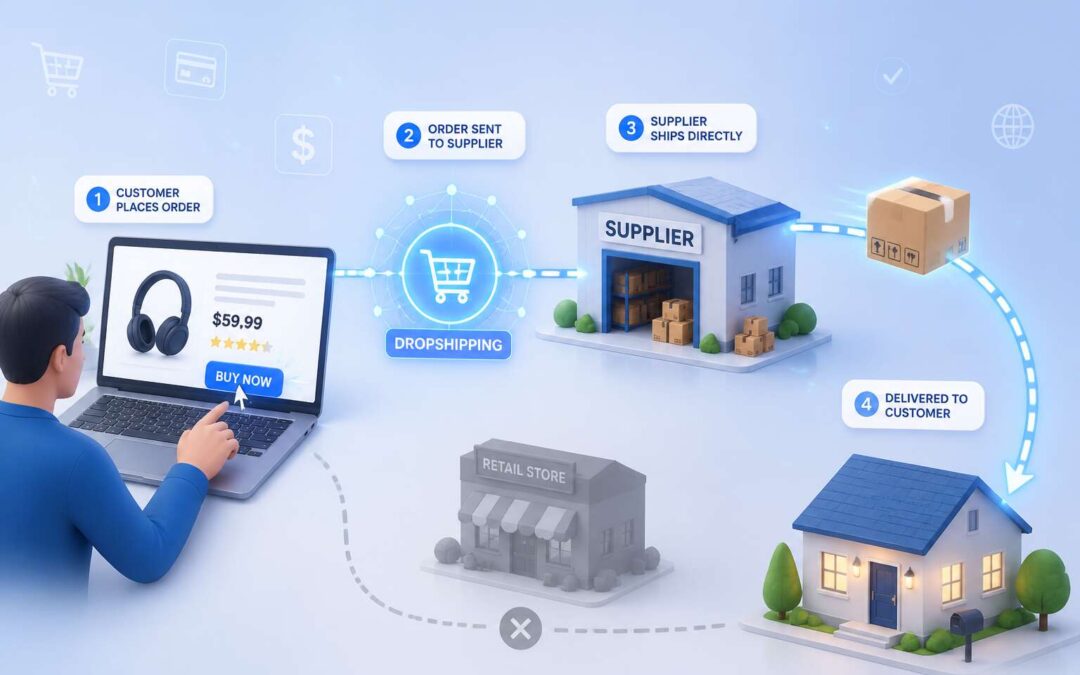
When the final click lands, the real work begins elsewhere. The customer’s payment clears, and the retailer forwards the order details to a supplier. That supplier retrieves the item from storage, packages it, and ships it directly to the buyer. The retailer never lays hands on the product.
The sequence is precise:
- The customer orders from the store
- The retailer relays the details to the supplier
- The supplier ships the product to the customer
- The retailer keeps the difference
This separation lies at the heart of what are dropshipping products. The seller controls the storefront, pricing, and customer experience. The supplier carries the burden of storage and logistics. For a South African entrepreneur, this means a business can operate from a laptop in Johannesburg while stock moves from warehouses in Durban or beyond.
Key Players: Retailer, Supplier, and Customer
The global e-commerce market is a vast ocean, and dropshipping products are the ships that navigate it. To understand what are dropshipping products, you must first picture a store with no shelves. A retailer lists an item for sale, but they never touch it. The product moves from a wholesaler to the customer, with the retailer acting as the unseen conductor of the transaction.
Instead of buying inventory upfront, the seller pays for the item only after the end consumer has paid them. The difference between the wholesale cost and the retail price becomes the profit margin. This model reduces financial risk significantly, but it also puts a premium on product selection. The item itself carries the entire weight of the business, as you cannot fall back on the quality of your physical storage or shipping speed.
Key Characteristics of Dropshipping Products
– No Ownership: The seller never possesses the inventory.
– Direct Fulfillment: The supplier ships the item straight to the final address.
– Scalability: You can list hundreds of items without a warehouse.
– Market-Dependent: The product relies on demand rather than your storage capacity.
The qualities of a good product are precise. It must be lightweight to reduce shipping costs, non-perishable to avoid damage, and it needs to solve a specific problem. Items like ergonomic desk accessories, specialized pet tools, or unique kitchen gadgets often perform well. These are not commodities you find in every supermarket; they are niche solutions that compel a buyer to click “purchase” overseas.
Yet, the landscape is always shifting. There is a constant tension between trending items and evergreen products. A viral gadget can generate enormous sales for three months, but the market can flood quickly, eroding the profit margin. Consequently, you often need to analyze market saturation and supplier reliability before committing to a niche. For a South African entrepreneur in Johannesburg, this means relying on a supplier in Guangzhou to deliver to a customer in Cape Town without ever seeing a single unit pass through your hands. The product is the starting point, but the process is the foundation, which brings us back to the core mechanics of how the business operates daily.
Typical Challenges and Solutions in Dropshipping
The question of what are dropshipping products rests on a simple truth: the item itself carries the entire customer experience. When a package arrives late or in poor condition, the buyer blames the retailer, not the supplier. You sell a promise, and the product is the proof of that promise. Pricing must account for invisible costs: exchange rate fluctuations, failed deliveries, and chargebacks.
Typical challenges are predictable. Suppliers run out of stock without warning. Competitors undercut prices within days of a product gaining traction. For South African sellers, currency volatility adds another variable. I have watched margins vanish on a single failed shipment. Successful operators typically respond by:
- Negotiating backup suppliers before they need them.
- Building a small safety margin into every retail price.
- Using tracking systems that notify customers proactively.
These measures address the structural weaknesses of the model without pretending they disappear.
Types of Dropshipping Products You Can Sell
Physical Goods vs. Digital Downloads
South African sellers must decide early whether their inventory arrives by courier or by email. Physical goods dominate the market, from artisanal homeware to imported tech accessories. Digital downloads offer a loophole. They sidestep shipping costs entirely, yet they demand a different kind of trust from buyers.
What are dropshipping products in this context? Simply items you never touch. Physical wares require warehousing partnerships and courier negotiations. Digital wares require a reliable download link and a customer who believes the file will arrive intact. I have watched sellers assume digital downloads are easier. They are lighter, but not simpler.
- Physical goods: tangible, prone to customs delays
- Digital downloads: instant, vulnerable to piracy
Physical inventory introduces variables like damaged parcels and return requests. Digital inventory introduces variables like refund disputes and platform compliance. Neither path offers a shortcut.
High-Ticket vs. Low-Cost Products
When you strip away the logistics and the marketing buzz, the question of what are dropshipping products comes down to a simple reality: they are items you sell without ever holding in your hands. Your store acts as a showroom, while a third-party supplier holds the stock and ships it directly to your customer. The financial barrier to entry is low, which is why so many South African entrepreneurs explore this model. It allows you to test interest in a niche without sinking capital into bulk inventory that might not sell.
The real strategic decision lies in choosing between high-ticket and low-cost products. Each path demands a different approach, and your choice will shape your daily operations. High-ticket items, such as specialised electronics or premium furniture, offer a significant profit margin on a single sale. However, sourcing reliable suppliers for these goods and managing customer expectations around shipping times requires far more hands-on support. A single delayed delivery can lead to a dispute that wipes out your earnings for that sale.
Conversely, low-cost products are the realm of impulse buying. These are phone cases, novelty accessories, and small fashion pieces that cost under R300. The volume needed to generate meaningful revenue is substantial, but the decision-making process for the buyer is faster. You capitalise on trends, which means you must constantly analyse search data and social media to spot rising demand quickly.
– High-ticket items demand patience and strong negotiation skills.
– Low-cost items require an aggressive marketing engine and rapid response to trends.
– The profit margin per unit is the key metric for high-ticket, while conversion rate is the metric for low-cost.
From a practical standpoint, the exchange rate heavily influences your pricing strategy. If you are sourcing products from international suppliers, you carry the risk of currency fluctuation. A weakening Rand erodes your margin before you even factor in shipping surcharges. Successful sellers often focus on products with a high perceived value that still remain affordable when converted to local currency.
Ultimately, understanding what are dropshipping products involves acknowledging that you are selling a promise of convenience. Whether you choose a R2,000 power tool or a R120 desk organizer, the core principle remains constant. You are the intermediary, responsible for the customer experience from the moment the order is placed to the day it arrives at their door, which means your supplier relationship is the true foundation of your business.
Evergreen Product Categories with High Demand
When you ask what are dropshipping products that stand the test of time, you are looking for goods with a permanent place in daily routines. Seasonal fads fade, but practical items survive market shifts. The savvy seller focuses on categories where demand is steady, not spiky, allowing for predictable marketing spend and supplier negotiations.
Home and kitchen accessories form a reliable cornerstone. These are the goods people need when they move into a new flat or replace a worn-out gadget. Think of durable storage solutions, efficient lighting, or clever cooking tools. They address a specific problem. The perceived value is high, and the return rate is often lower than with fashion items. It is much easier to satisfy a customer with a sturdy, functional item than with a garment that might not fit.
Another robust sector involves personal care and wellness tools. Here, you sell the promise of a better morning routine. Items like massage rollers, sleep aids, or posture correctors appeal to a universal desire for comfort. Buyers are not looking for a luxury; they want an improvement. By sourcing products that deliver on that simple promise, you build a loyal customer base that trusts your selection criteria.
For a practical look at the landscape:
1. Home organisation: Shelving units, closet dividers, and modular boxes.
2. Auto accessories: Phone mounts, seat organisers, and interior LED lights.
3. Pet supplies: Grooming gloves, interactive feeders, and travel bowls.
The South African market places a premium on durability. A product that breaks after two uses creates a dispute and a negative review, which harms your seller rating quickly. When selecting from these categories, scrutinise the material quality and read the negative reviews carefully. That is where the truth about the product’s lifespan lives. This diligence is precisely what separates a sustainable operation from a short-lived experiment. So, when people ask what are dropshipping products, the answer lies in identifying items that promise longevity and dependability, not fleeting excitement.
Seasonal and Trending Product Opportunities
Seasonal products reward the seller who reads the calendar. In South Africa, winter evenings push electric blankets and thermal wear to the front of search results. Summer flips demand to portable coolers and braai tools. The challenge lies in timing. A trend can vanish overnight, leaving you with dead stock. But the upside is real. One viral item can fund months of slower sales. Examples include:
- Festive season decor and gift bundles
- Back to school stationery kits
- Load shedding survival gadgets
These opportunities answer what are dropshipping products in a different way. They are not dependable, but they are powerful. The seller who tracks social media chatter and local holidays can capitalise. Inventory levels and supplier lead times matter most. When a trend peaks, your window closes. So, what are dropshipping products? They are sometimes a bet on the zeitgeist, not a staple.
Niche Products for Targeted Audiences
The conventional online shelf chases everyone and captures no one. Niche dropshipping works differently. When consumers ask what are dropshipping products, they imagine mass items like phone cases or generic apparel. Yet the most loyal buyers emerge from smaller pockets of obsession.
South Africa makes this visible. A store dedicated to reptile husbandry supplies serves a thin population, but those owners buy consistently. They need UVB bulbs calibrated to local seasons. They need enclosure thermostats. They need live food packaging. No broad retailer bothers with those specifics.
Targeted audiences reward precision:
- Specialised saltwater fishing tackle for the KwaZulu-Natal coast
- Gluten free baking mixes for coeliac households
- Hobbyist 3D printer filaments in obscure colour ranges
The true answer to what are dropshipping products is sometimes narrower than the catalogue suggests. You are not predicting mass behaviour. You are serving a defined community whose needs are poorly met elsewhere. That clarity lowers refund rates and fosters repeat custom, and I have seen it outperform every generic storefront I have tested.
Criteria for Selecting Profitable Dropshipping Products
Assessing Market Demand and Consumer Trends
In a market where 63% of consumers expect personalized recommendations, the real question about what are dropshipping products transforms from a simple definition into a search for viability. Selecting profitable items requires more than gut feeling; it demands a look beneath the surface. The initial excitement of a product idea often fades when you examine the logistics of shipping times and supplier reliability. A product that is beautiful in a photo can become a logistical burden if the supplier cannot deliver consistently. Therefore, you must weigh the potential profit margin against the hidden costs of returns and customer service.
Assessing market demand is a continuous practice, not a one-time event. You are looking for a pulse, a consistent rhythm of interest that indicates a steady stream of buyers. Consumer trends offer clues, but they also present a maze of fleeting fads. The key is to discern between a perennial need and a temporary spike in attention.
To help you gauge this, consider these indicators of sustained interest:
– Steady growth in search volume over a period of months, rather than a sudden peak.
– Active social media communities and forums where users discuss the product or its use case.
– A healthy number of suppliers offering the product, which indicates a stable supply chain.
Once you see these signals, you can begin to validate the product’s longevity. This analysis is where the true art of determining what are dropshipping products becomes tangible. You are not just picking an item; you are selecting a vessel for customer satisfaction. If the demand is built on shaky ground, such as a viral video, you risk investing in a ghost that will vanish by the next quarter. Instead, look for products that solve a recurring problem or improve a daily routine. This focus on enduring utility ensures your effort builds a foundation for repeat business and organic word-of-mouth. The tools for this research, from keyword planners to social listening platforms, are the same instruments used by large retailers, but your application of them can be more agile and personal. That agility is your advantage, letting you pivot before the trend becomes saturated, always keeping the customer’s unspoken desire at the core of your strategy.
Calculating Profit Margins and Price Competitiveness
Let’s be blunt: not every product deserves a spot in your store. The difference between a passive income stream and a digital paperweight often comes down to two ruthless calculations: your profit margin and your price competitiveness. You might fall in love with a shiny gadget, but if the numbers don’t work, that romance will end in a warehouse full of unsold inventory.
To figure out if an item is worth your time, you must strip away the marketing gloss and look at the raw arithmetic. The formula is simple: start with your selling price, subtract the supplier cost, the shipping fees, and the advertising spend. What remains is your actual profit. If that number is less than a cup of coffee, you are essentially running a charity. A healthy margin usually sits above 30%, giving you the breathing room to cover refunds, failed deliveries, and the occasional customer who believes the parcel should have arrived by pigeon.
Here are the core criteria to run your product ideas through before you commit:
– The 3x Rule: Ideally, you want to sell the item for at least three times what you paid for it.
– Shipping Weight: Light and small is always better. Heavy items eat your margin in courier fees.
– Breakage Potential: If it shatters when dropped, you will eat the cost of replacements.
– Return Rate History: A product with a high return rate is a ticking time bomb for your cash flow.
Price competitiveness is a different beast entirely. With dropshipping, you are rarely the only seller offering that specific ergonomic whisk or foldable travel hanger. This means you cannot simply slap a random 50% markup on the price and expect magic to happen. You must analyze the current market saturation. If the market is flooded, the race to the bottom begins, and you will find yourself offering free shipping just to keep your head above water.
Instead of fighting for the lowest price, consider the value you add. A customer might pay a premium if your product page is clearer than the competitor’s, if you offer faster dispatch, or if you provide superior after-sales support. However, you need to be realistic about the ceiling. If the perceived value of what are dropshipping products in your niche is capped at R500, you will struggle to justify a R900 price tag. The key is finding that sweet spot where your margin is healthy, but your price still feels like a bargain compared to the alternatives.
Evaluating Supplier Reliability and Shipping Speeds
After the arithmetic works, the real test begins with supplier reliability. A brilliant product page means nothing if your supplier disappears after payment. I always order samples first, timing how long they take to arrive. If a supplier delivers a sample in three weeks, expect a bulk order to take three months. This is the reality of what are dropshipping products: you are selling someone else’s promises. You need suppliers who answer messages within hours, not days.
Shipping speeds matter just as much. South African customers want tracking updates, not silence. Watch for these warning signs:
– No physical address or phone number listed.
– Tracking numbers that never move.
– Reviews that mention missing parcels.
A reliable supplier is the foundation of your operation. Choose poorly and you will spend every evening apologising to customers.
Considering Product Quality and Return Rates
Every returned item costs twice: once in shipping and once in reputation. That is why understanding what are dropshipping products must include a hard look at quality and return rates. A supplier can promise premium materials, but the customer will test that promise through physical handling.
Product specifications deserve scrutiny. Raw material certificates provide one layer of evidence. Sample orders often reveal durability problems before they reach customers. Customer reviews expose patterns of breakage or fading. A return rate above 5% marks a warning, not a challenge.
- Listing photos that hide seams or edges.
- Descriptions that avoid exact measurements.
- Reviews that mention ‘cheap’ or ‘flimsy’ repeatedly.
Durability determines whether margins survive. Refunds flow from products that fail under normal use.
Avoiding Saturated Markets and Legal Pitfalls
Sourcing and Managing Your Dropshipping Product Line
How to Find and Vet Trustworthy Dropshipping Suppliers
Every South African entrepreneur who asks what are dropshipping products soon learns that the supplier determines success. A beautiful storefront means little when a package arrives late or a customer opens a damaged box.
I have learned to verify every supplier before signing. Order samples to test quality and shipping speed. Confirm business registration details. Speak with existing clients rather than relying on testimonials.
- Response time to enquiries within 24 hours
- Consistent packaging that protects fragile items
- A clear return and refund policy
Managing your product line demands ongoing reviews of these signals. A supplier who performed admirably for one product may stumble on another.
Testing New Products Before Committing to Full Scale
A single bad product launch can erase months of profit. This is why testing new products before committing to full scale is the difference between a thriving store and a costly graveyard of unsold stock. The process starts small, almost invisibly. You order a handful of units from your supplier and run a limited campaign to a small audience segment.
The data from this initial wave tells you everything. You are not looking for massive sales numbers yet. You are searching for signals that confirm the product can hold its own in a real marketplace. I always track a few specific markers during this phase:
– Customer return requests, which reveal if the product matches its description
– The time between order placement and dispatch confirmation
– Organic social engagement from users who are not following you
These indicators often speak louder than any conversion rate. If the product passes this small scale scrutiny, you can gradually increase your ad spend and inventory levels. The transition should never be sudden. Each increment of scale needs to prove itself before you commit more capital. This disciplined approach has saved my business countless times. A product that performs well for a competitor might fail for you due to supplier variations. Always test in your own environment and judge based on your own metrics.
Managing your product line means knowing when to cut losses. Some products fail quietly, with no single catastrophic event, just a slow bleed of return requests and negative feedback. You must be willing to pull the trigger and remove them from your catalog. This ongoing cycle of testing, scaling, and pruning is the real work behind the question of what are dropshipping products. It transforms the concept from a passive activity into an active, strategic discipline.
Automating Inventory and Order Processing Systems
When a store reaches a certain order volume, manual inventory tracking becomes a liability. Automation is the only reliable way to maintain accuracy. Your system should trigger purchase orders to suppliers the moment stock hits a predetermined threshold. This prevents the dreaded oversell, where you take payment for a product you cannot ship.
Order processing benefits from the same level of automation. Every sale should generate a fulfillment request to your supplier without manual intervention. This synchronization is critical as you expand your offerings and the question of what are dropshipping products evolves into a question of logistics. Consider what a unified dashboard provides:
– Real-time stock levels across multiple suppliers
– Automated tracking number collection and customer notification
– A centralized hub for returns and refund requests
Without this infrastructure, scaling your product line becomes a chaotic exercise in spreadsheet management. Automation turns the operational chaos into a manageable stream of data. It gives you the bandwidth to focus on product curation rather than administrative tasks. The discipline of testing and pruning becomes effective only when your backend can handle the influx of data and orders. This is the machinery that supports strategic decisions. So when people ask what are dropshipping products, the answer often lies in the invisible systems that make selling them possible.
Handling Customer Service, Refunds, and Replacements
Sourcing and managing a product line goes beyond picking winners. Each supplier must prove how they handle replacements. I ask for their defective item timeline before I list anything. This matters most when customers search for what are dropshipping products and expect a clear swap process. I track every supplier’s response speed monthly.
Customer service, refunds, and replacements form the daily core of this model. A refund request should follow a simple flow. Confirm the order number, then contact the supplier for their policy. I keep a one hour response rule during business hours.
- Verify the order number
- Check the supplier’s return policy
- Approve a refund or request a replacement
South African shoppers value a direct answer when a product fails. A quick refund creates loyalty, while a slow one costs future orders.
Building Strong Relationships with Your Suppliers
Building a reliable product line starts with how you treat your suppliers. I treat them as partners, not order takers. After every sales surge, I share the numbers with my main suppliers. This transparency lets them prepare stock before I ask.
Customers who google what are dropshipping products often picture a warehouse they own. They do not realise the supplier holds that inventory. So my relationship with each supplier determines whether orders reach South African doors on time.
- Keep a shared inventory spreadsheet
- Set response time expectations
- Review shipping performance quarterly
Strong supplier relationships do not happen by accident. They require routine check-ins and honest feedback. When a supplier knows your sales pattern, they protect your margins during stock shortages.
Marketing and Scaling Your Dropshipping Product Business
Crafting Effective Product Listings and Descriptions
Your product listing is the silent salesperson working the midnight shift while you sleep. In the bustling e-commerce landscape, where customers make snap judgments in seconds, understanding what are dropshipping products means understanding how to present them with magnetic appeal. The difference between a casual browser and a confirmed buyer often comes down to how your product page speaks to their needs, desires, and pain points.
Marketing your dropshipping venture starts with crafting listings that tell a story, not just list specifications. Customers want to envision the product in their daily lives, solving a nagging problem or delivering a moment of joy. Use vivid language that paints a picture, highlight the transformative benefits rather than raw features, and always address the unspoken questions lurking in the buyer’s mind. A compelling headline grabs attention, but persuasive bullet points seal the deal. Consider these essential elements for every listing:
- Feature-focused headings that promise a specific outcome or solution
- Scannable benefit bullets that break down the value proposition clearly
- High-quality images from multiple angles and lifestyle contexts
- Clear pricing, shipping expectations, and return policies to build trust
- Social proof elements like ratings and customer testimonials
Scaling your dropshipping business hinges on identifying your top-performing listings and doubling down on their strengths. Once you establish what are dropshipping products that resonate with your audience, you can refine your marketing angles, adjust your ad spend, and expand into complementary product categories. Consistency in your brand voice across all listings creates a cohesive shopping experience that encourages repeat purchases and word-of-mouth referrals.
Strong marketing and scaling strategies go hand in hand, allowing you to transform a simple product page into a conversion machine. By continuously testing different headlines, images, and descriptive styles, you gather invaluable data about your audience. In this fast-moving industry, the sellers who adapt their listings based on real performance metrics emerge as the clear winners.
Leveraging Social Media and Influencer Marketing
Marketing your dropshipping business through social media and influencer partnerships requires a sharp strategy, not just a presence. The days of passive posting are over; to truly scale, you must leverage communities where your target audience already interacts with trusted voices. This approach transforms casual scrollers into paying customers by building a bridge of authenticity between their world and your product. The key is to move beyond simple product placements and into storytelling that feels organic to the influencer’s content style.
To maximise your return on investment, consider a structured approach to your campaigns. A focused strategy ensures you are not spraying and praying but rather aiming with precision:
1. Identify micro-influencers who boast high engagement rates within your specific niche, rather than chasing massive follower counts.
2. Provide them with creative freedom and unique discount codes to track performance, which also gives their audience a tangible incentive to purchase.
3. Repurpose their high-quality content across your own paid social ads to build social proof and lower your customer acquisition costs.
Scaling your venture hinges on this data-driven cycle of testing and iteration. By analysing which influencer content and ad creatives yield the best return, you can allocate more budget to the winners. This continuous loop of optimisation, grounded in authentic social proof, is the engine that takes a simple dropshipping operation and turns it into a sustainable, growing brand. Understanding what are dropshipping products is only the start; mastering the distribution channels is where the real growth happens.
Using Paid Advertising for Targeted Traffic
Paid advertising is the engine that accelerates a dropshipping business beyond organic reach. Social media and influencer partnerships build awareness, but targeted ads capture demand from users already searching for solutions. For South African entrepreneurs, platforms like Google Ads and Meta offer precise demographic and interest targeting, which is crucial when competing with established local retailers.
The transition from organic content to paid traffic requires a shift in strategy. You move from creating broad awareness to driving specific, measurable actions. The data from these campaigns reveals exactly which products resonate and which audiences convert. This clarity allows for rapid budget reallocation, a significant advantage when margins are tight, which is often the reality when you consider what are dropshipping products and their associated costs.
Once a product demonstrates consistent sales from organic traffic, it is time to scale. Increase spend on the winning ad sets while pausing underperformers. This process of iterative testing is the key to sustainable growth.
– Analyse your customer acquisition cost against your profit margin.
– Test different ad creatives to find the most effective messaging.
– Use retargeting campaigns to capture visitors who did not purchase initially.
This systematic approach ensures every Rand contributes to a scalable, profitable operation.
Implementing Email Marketing and Retargeting Campaigns
Email lists are the quiet workhorses of a profitable dropshipping business. While paid traffic brings visitors to your store, email marketing turns casual browsers into repeat buyers. The money is in the follow-up. A well-timed email sequence can recover abandoned carts and introduce new products to an audience that already trusts you. In South Africa, where data costs can be prohibitive, a direct message to an inbox often outperforms a social media ad. Retargeting campaigns work alongside this. They remind people who left your site without purchasing that their desired product is still waiting for them.
These two strategies work best in concert. Retargeting keeps your brand visible across the web, while email nurtures a deeper connection. The cost per conversion drops significantly when you combine them. This is where you truly understand what are dropshipping products in a business sense. They are not just items you sell. They become vehicles for data collection and customer relationships. The margins improve when you stop paying for every single visit and start leveraging your existing audience.
Consider this approach when building your campaigns:
– Segment your email list based on browsing history and past purchases.
– Send a discount code to subscribers who have not engaged in 30 days.
– Create a retargeting audience from your highest value email subscribers.
Analyzing Data to Optimize Performance and Scale
The data you gather from those email campaigns is pure gold. It tells you more than just who is buying. It reveals exactly what are dropshipping products that your specific audience craves. This moves you past guessing games. You can finally see which items generate real interest and which ones just sit there. This is your roadmap for scaling.
Now, you can shift from reactive selling to strategic growth. Look for patterns. Products that sell consistently during a promotion might have staying power. Items that only move with heavy discounts are probably not your long-term winners. Instead of pumping money into everything, double down on what works. Increase your ad spend on the top performers. This is how a simple store transforms into a serious brand.
Here are a few key metrics to watch closely as you evaluate your data:
- Customer Acquisition Cost versus the average order value.
- Repeat purchase rate from your email list.
- Profit margin per product after accounting for shipping fees.
When you review these numbers, you face a simple truth. Some products are just too expensive to ship from overseas suppliers. The high shipping costs eat into your margin. This is where the concept of what are dropshipping products becomes clear. They are not just inventory. They are your core business tools. You need to ensure the supply chain is reliable. A long shipping time can kill a good product. A broken item can destroy your reputation. So, analyse the feedback and return rates. They are direct signals from your customers about the real-world performance of your choices.
Ultimately, scaling is about letting go of underperformers. It is about trusting the data over your personal feelings. When you see a product with a high return rate, remove it. When you see a product with a high profit margin and low return rate, push it harder. This constant cycle of analysis and optimisation is the engine of growth. It turns a random list of items into a profitable, focused business.
Expanding Your Product Portfolio Based on Insights
Marketing a dropshipping business in South Africa requires a clear view of what are dropshipping products that generate consistent sales. When your email campaigns and ad data point to a specific category, expand within that category rather than branching into unknown territory.
Your existing customers offer the clearest signal. If they repeatedly purchase eco-friendly kitchen tools, introduce variations. New colours, sizes, or bundled sets can attract fresh attention without the risk of a completely untested product line. This is the practical answer to what are dropshipping products in a scaling context: they are proven items, refined and extended.
- Review your top selling items each month.
- Identify common traits among them.
- Source similar products from your existing suppliers.
This approach keeps your marketing budget focused. You already know the audience. You already know the price points. Scaling becomes a matter of depth, not guesswork.